
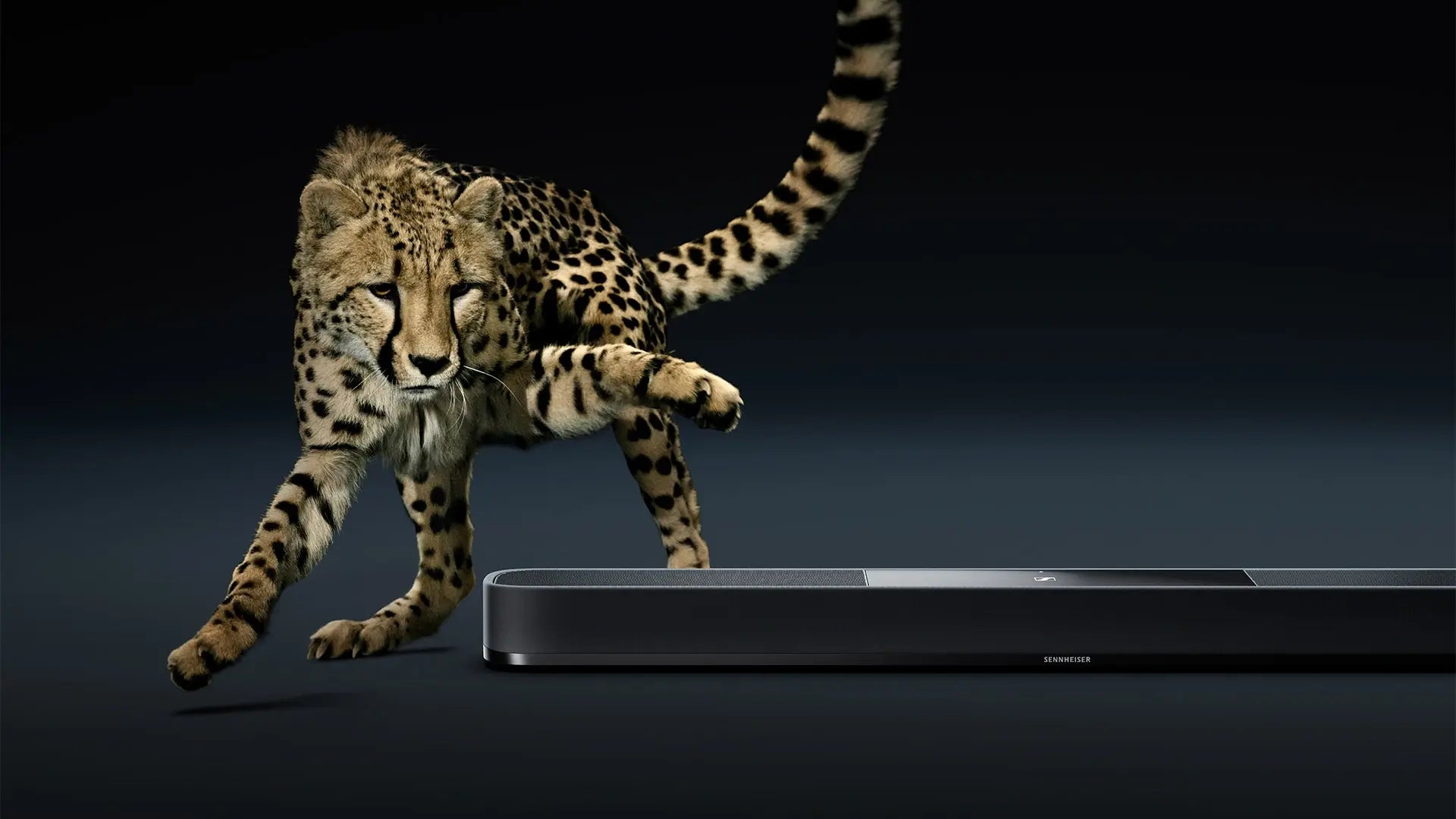
Film director Isao Yukisada has won numerous film awards, including the Japan Academy Prize for Best Director. The music and sounds used in his films are extremely delicate and deeply move the hearts of viewers. We asked Director Yukisada, who values the power of sound, how the sound of Sennheiser's Ambio Soundbar Plus resonated with him.

What is the role and significance of music in film?
YukisadaBasically, movies are a "sequence." They are a series of images, but if there is a created image, it is the sound that gives it a sense of presence. When I edit, I often remove the sound. That is to check whether the movie can be fully enjoyed just by looking at the images. First of all, that is what makes a movie, but what makes it most interesting, or even more interesting, is overwhelmingly music and sound. When sound is added, the sequence of images that was created is shown to the audience, but it also creates more depth, and the sound can evoke memories from history and other things that the audience is not seeing, from their own real-life experiences. That directly touches the heartstrings, stimulates the tear ducts and brings tears to the eyes. I believe that this is overwhelmingly the power of sound. It doesn't happen if you just look at the images, or if you look at it with the sound off. The sound adds persuasiveness. For example, the characters, the situation of the protagonists standing there, it's the sense of presence. Therefore, sound is extremely important because it's the thing that resonates most directly with the audience.
What aspects of sound do you particularly focus on when making films?
YukisadaIt's called sound design. If there's music, then I try to balance it with the dialogue, monologues, and things like that. When the music suddenly stops and becomes absent, it's not like a loud noise comes in the moment the music is gone, but rather it connects to the silence. If you simply include the sound of the river that was recorded on set, for example, if there's a river flowing, then the music and the sound of the river are directly connected at the same level. When the music that was there gently fades away, it connects to the sound of the river. But their dialogue is placed in the silence, and then at some point, the sound of the river becomes audible. I have a habit of trying to strike that kind of balance, so that when the music is subtracted and disappears while the atmosphere is connected, it connects to the atmosphere that the music evoked. The silence that follows is actually just as powerful and moving as the presence of a lot of sound and music; it's a subtractive effect, but it holds even more meaning than the presence of sound or music. I think that kind of thing is really important.

What are your thoughts on the sound of movies watched at home?
YukisadaWe finish our films with the understanding that they will be experienced in a theater, and we consider the screen size and check the sound projected onto the screen. The environment in which we create the sound is almost the same as that of a movie theater, and we create the sound with the assumption that it will be heard in a movie theater. However, with the proliferation of subscription platforms and the availability of various videos via streaming, people tend to think, "I can just watch it at home instead of going to the theater." My biggest dilemma is that the sound is lost when it reaches the audience. The sound doesn't become three-dimensional. In short, it's two-dimensional. Even with the emergence of things like VR, the concept of movies being viewed on a flat surface, and the same goes for TV dramas, remains unchanged. The quality itself is all the same, but when you watch it on a monitor, in other words, in your living environment, all the sounds from around you, such as the sounds of people you live with, or the sound of the toilet, all come in. It's quite difficult to block out all of that, but I think that's probably related to the viewer's attitude as well.
What's your impression of the Sennheiser brand?
YukisadaWell, it's simply that the sound is great. People in the film industry fundamentally use Sennheiser microphones and monitor the sound, and all the technicians use Sennheiser headphones. On a film set, the sound is very lifelike. You can hear everything clearly. For example, the nuances of the ending of each line of dialogue, or even chewing sounds—you can hear everything so clearly and three-dimensionally that nothing is missed, which is why it's so highly regarded. It adds a sense of realism. The fact that it picks up sounds that those people normally can't hear expands the range of expression and imagination. We can hear those things clearly even when we're filming, and that's why we can further emphasize them and connect them to our expression. It makes us want to develop it even more. The power of sound is really important.

AMBEO Soundbar | Plus


What did you think of the sound quality after experiencing the Ambio Soundbar Plus?
YukisadaA lot of thoughts were running through my mind, but as I just mentioned, I felt like this could resolve my own dilemma. The sound really comes through so effectively. This is something I can say to others as well, but I felt like it played a role in reaching the audience's sensibilities in a way that was intentional. It was overwhelmingly three-dimensional. I was a little surprised. I even thought, "I wonder if I could put this in my place." It's a size that makes you think, "I could definitely put this there." The fact that it can do that is amazing. If I had this, I might even want to dig out that movie I saw in the theater and watch it again, or buy it and watch it. There's something about it that makes you want to prioritize watching movies with good sound. The impact is really direct, and it creates an environment where the world of the movie is really created between you and the monitor at a very close distance. I think that's just wonderful.

(Among your own works that you would like people to watch with the Ambio Soundbar Plus, such as "Rivers Edge" and "Five Minutes to Midnight") What were your impressions of watching "Rivers Edge" with the Ambio Soundbar Plus?
YukisadaIn the second half, there are parts where there is only music and narration, and the dubbing process, the final post-production, was extremely difficult. The world view created by the musician Yuko Sebu was like a wavering dream, and the music had an incredible breadth to it. I wanted the narration to be clearly audible within that music, and I wanted to assert this music, but if I made it too prominent, the narration would get lost, so I used the Ambio Soundbar Plus to see if the narration was properly three-dimensional, and of course the sound is excellent. The most important thing was the stillness of the night, the scene where the two boy and girl are standing on the Ogawa Bridge in the middle of the night, and I wanted to make that scene extremely quiet. In the climax, the final scene, there are only scattered lines of dialogue, and I've always believed there's something good about the sound design there. This is reproduced in the film, but in a home environment, the sound range is too narrow, making the atmosphere flat. I was curious to see how it would turn out with the Ambio Soundbar Plus, and it did a great job of creating a crisp, decisive silence, with the dialogue placed only sporadically. In other words, it created a three-dimensional effect.

What other directors' films would you recommend watching with the Ambio Soundbar Plus?
YukisadaThere are a few, but there's Steven Spielberg's film 'Saving Private Ryan,' which is set on a battlefield. It's on the very front lines, with gunfights, and you hear the sounds of bullets hitting people or just passing through them. The impact is so powerful; Spielberg makes you experience firsthand just how cruel and horrifying it is to be on the front lines, to witness such brutal and foolish acts of killing. In the first half of the film, the sound engineers create the kind of three-dimensional sound that people all over the world imagine. I just thought that I'd really like to see that.
What do you think of the size and design of the Ambio Soundbar Plus?
YukisadaIt's simple and nice. There's nothing unnecessary, and it's easy to understand that this is how much sound you get just by connecting it with a wire. (The design) is not flashy, which is good. I really like the black color, though.

Who would you recommend the Ambio Soundbar Plus to?
YukisadaOf course, movie lovers would love it, but also busy people who can't easily go to the cinema, or mothers with young children who watch Korean dramas after their kids have gone to sleep. I think they'll really enjoy it. And for those who are truly passionate about movies and want to immerse themselves in them, this will give them an experience that's almost like being in a cinema. Even at low volume, it sounds great, and because you're so close to the monitor, it creates a completely private cinema environment. Also, for people living alone in Japan, it instantly transforms a small space into a private theater. At this close distance. It's perfect for those kinds of people. I thought it was great because it doesn't take up much space, and even though my studio isn't that big, I thought I'd like one for my studio.

How did you like the sound system of the Ambio Sub?
YukisadaClearly, deep bass is a very important part. After all, it's about the feeling of the ground shaking, the sense of presence. If the bass doesn't resonate, you don't really feel it, because it's a wave. It's like the sound, the pressure of the sound, is directly applied to your body, and that really draws you into the world, and conversely, it's that contrast, that sudden burst of sound in the silence I mentioned earlier. It really shakes the air. Sound is deep bass, so that's something I consciously make the most important in movies. It's the same with movie music, and the impact is clearly different depending on whether or not that deep bass that shakes the ground is present. It's hard to feel that in a home environment. That's what I felt when I listened to it. Clearly, I thought, "They've done this!?"
Has your experience with Ambio changed your perception of having people watch movies at home?
YukisadaYou can add something extra, right? There's an enjoyable element. As a filmmaker, it's incredibly rewarding to know that even a little bit of what we envisioned is conveyed.
Target products
-
PayPay決済でPayPayポイントが追加で9.5%付与!
-
PayPay決済でPayPayポイントが追加で9.5%付与!

